







Article: Chinese Matcha vs Japanese Matcha
Chinese Matcha vs Japanese Matcha
Where Your Matcha Is Grown: Japan, China, and the Terroir Behind the Bowl
Matcha is having a global moment. As demand climbs faster than supply, more of the green powder on shelves comes from places that, until a few years ago, no one associated with it. If you care about what's in your bowl, it's worth understanding where matcha is actually grown, and why the where matters more for matcha than for almost any other tea.
Why origin matters more for matcha
With most teas, you steep the leaves and pour off the liquid. Whatever the leaf absorbed during its life, minerals, but also whatever was in the soil and air, largely stays behind in the spent leaves.
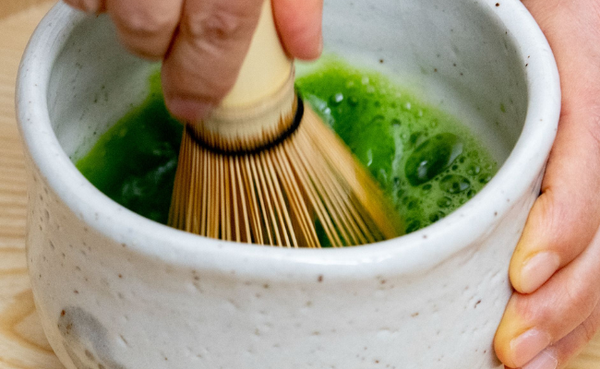
Matcha is different. The whole leaf is stone-ground into powder and whisked into water, so you drink the entire leaf. That's the source of matcha's famous concentration of antioxidants and L-theanine, and it's also why the growing environment, the soil, and the farming standards behind a given matcha matter so much. With matcha, terroir isn't a marketing word. It's the whole leaf, in your cup.
Japan: the heartland of matcha
Japan has refined matcha cultivation for roughly 800 years, and a handful of regions still define what the world considers great matcha. The differences between them are real, the same plant grown in two regions produces noticeably different tea, the way the same grape produces different wine in Burgundy versus Oregon.
Uji (Kyoto). The spiritual home of matcha, where Zen monks first planted tea seeds brought from China in the 13th century. Uji's river mist, mineral-rich soil, and pioneering shading techniques produce matcha prized for deep umami, creamy texture, and minimal astringency. It remains the benchmark for ceremonial-grade tea. Explore our single-origin Uji matcha →
Nishio (Aichi). A quieter powerhouse with a tea history nearly as long as Uji's. Today it's one of Japan's largest matcha hubs, with fields dedicated almost entirely to tencha, the shade-grown leaf that becomes matcha. Nishio is known for balanced, consistent matcha that works beautifully both in the bowl and in a latte.
Shizuoka. Japan's largest tea-producing prefecture overall, and the source of much of the country's everyday matcha. Its balanced, approachable profile makes Shizuoka a natural home for high-quality daily-drinking matcha, clean, reliable, and grown under some of the most established standards in the country. Where our biggest farm is currently based →
Kagoshima. On the southern tip of Kyushu, with rich volcanic soil and a warm climate. Kagoshima has become the largest tencha producer by volume in Japan, and its bolder, more robust matcha holds up especially well against milk. Explore our single-origin Kagoshima matcha →
Yame (Fukuoka). A small, mountainous region celebrated for its gyokuro, using the traditional honzu shading method with natural reed screens rather than synthetic netting. The result is limited quantities of deeply terroir-driven matcha.
What ties these regions together isn't just heritage, it's a dense web of cultivation standards, shading traditions, and quality controls refined over centuries.

China: the new producer at large scale
Here's what most matcha drinkers don't realise: China has become a major matcha producer, and quickly. Green tea has grown there for thousands of years, but modern, Japanese-style matcha is a recent development driven by global demand.
Zhejiang. The early mover, with production concentrated around Hangzhou, Shaoxing, Jinhua, and Ningbo. Decades of investment have made it one of the largest matcha-producing regions in the world by volume, much of it aimed at culinary-grade powder for lattes, baking, and packaged foods.
Guizhou. A genuine surprise. In the high-altitude, mist-shrouded mountains around Tongren, near the Fanjing Mountain natural heritage site, the region has built a matcha industry almost from scratch since 2017, complete with one of the largest single-site matcha factories in the world.
It would be inaccurate, and unfair, to dismiss all Chinese matcha as low quality. The best of it can be grown thoughtfully and tested carefully. But the honest picture is that China’s output spans an enormous range, from good quality tencha to inexpensive industrial powder. And with such a wide spectrum, the real question is not simply where the matcha comes from, but how transparently it is grown, processed, tested, and traced. In some cases, lower-cost matcha may come with less visibility around farming practices, environmental exposure, pesticide controls, heavy metal testing, and full supply-chain traceability, which is why rigorous testing and trusted sourcing matter so much.

Air quality in East Asia (PM2.5):
Study from IQAir, a Swiss air quality technology company, specializing in protection against airborne pollutants, developing air quality monitoring and air cleaning products.


Green -> Less Polluted // Red -> More Polluted . Study made by World Air Quality Report (2021)


Summary - Air quality in East Asia (PM2.5)
Across data from 1,347 cities in East Asia, 143 of them (about 11%) recorded annual average PM2.5 concentrations more than seven times WHO's guideline value of 5 µg/m³ , and all 143 were in China. The region's most polluted city was Hotan, China, with an annual average of 101.5 µg/m³, over 20 times the WHO guideline. Handan, China posted the region's largest absolute reduction, falling from 58.9 µg/m³ in 2020 to 45.6 in 2021. Japan remains the regional country with the best air quality, with a 7% reduction in 2021 versus 2020; of the 529 Japanese cities reporting in both years, 81% saw improvements. Japan's cleanest readings came from Ogasawara and Minami Ward (5.3 µg/m³), while Tanabe improved by more than 35% (from 9.0 to 5.8 µg/m³). Outside Japan, the Mongolian towns of Sumber and Chonogol were the region's least polluted.
A final, fair note: pointing to air quality or soil studies doesn't mean every cup of Chinese tea is compromised. The most polluted cities tend to be industrial centres, not tea country, and China's matcha is grown in high-altitude regions like the mountains of Guizhou. The honest takeaway isn't "one country good, one country bad." It's that the environment a tea grows in genuinely matters, and that the only way to know what's in your bowl is a traceable origin and independent testing, wherever that tea comes from.
The question that matters isn't the country. It's what you can verify.
It's tempting to reduce all this to "Japanese good, everything else bad." The truth is more useful than that.
Tea plants draw whatever is in their environment up into their leaves, minerals, but also heavy metals like lead and cadmium, and any pesticide residue. Because matcha is consumed whole, those things matter more here than in steeped tea. Studies over the years have flagged lead and pesticide concerns in some teas grown near industrial areas and busy roads. But the same research also shows that contamination is region- and farm-specific, not simply a matter of which country a tea comes from.
Two things follow from that:
- "Organic" alone doesn't guarantee purity. Organic certification means the tea was grown without synthetic pesticides, an important thing. But it doesn't, on its own, certify that a matcha is free of heavy metals absorbed from soil or air. (Ocha & Co Test →)
- A country name on the tin isn't the same as a known source. "Product of Japan" can still be a blend of anonymous leaf. What actually protects you is a traceable origin, organic certification, and independent third-party testing for residues and heavy metals.
That's the real takeaway. The most reassuring matcha isn't the one with the most patriotic packaging, it's the one whose producer can tell you exactly which farm grew it, under which certification, and show you the test results.
Where Ocha & Co. stands
We source our matcha from a single, long-standing partner farm in Shizuoka, Japan, a relationship built over years, not a spot purchase from an anonymous broker. Our tea is organically certified across multiple international schemes, and it's independently tested. We can tell you where every leaf comes from, because we know.
We think that's what origin should mean: not a slogan, but a chain you can follow all the way back to the soil.
Explore our 100% Organic Shizuoka matcha →